How Much Does a Septic System Cost in Minnesota?
Short answer: most conventional septic systems in the Scott and Dakota County area cost $10,000 to $25,000 installed, and mound or advanced systems run $25,000 to $50,000 or more. This guide explains what drives the number, line by line, so you can read any quote with confidence.
Answer first: 2026 planning ranges
| Project | Typical range (installed) | When it applies |
|---|---|---|
| Conventional trench / bed system | $10,000 – $25,000 | Suitable soils with enough separation to groundwater or bedrock |
| Mound system | $25,000 – $45,000 | Shallow soils, clay, or seasonal high water table |
| Advanced treatment system | $30,000 – $50,000+ | Shoreland, tight lots, poor soils, or performance requirements |
| Replacement (any type) | Above range + $1,000 – $4,000 | Old tank pumping, abandonment or removal, and site restoration |
| Design & site evaluation | $1,500 – $4,000 | Required before permitting on every project |
| Compliance inspection | $300 – $800 | Property sales (required in Dakota County), permits, additions |
Every figure in this guide is a planning estimate for the south metro exurbs of Minnesota in 2026, drawn from the sources described in the methodology note below. Septic pricing is site-specific by nature: two lots on the same road can price $15,000 apart because of what is under the grass. Use the ranges to budget and to sanity-check quotes — then get the written, site-specific number.
Cost by bedroom count
Minnesota sizes residential systems by bedrooms because bedroom count predicts wastewater flow. More bedrooms mean a bigger tank and a larger soil treatment area, and on mound systems a bigger mound.
| Home size | Conventional | Mound |
|---|---|---|
| 2 bedrooms | $10,000 – $18,000 | $25,000 – $35,000 |
| 3 bedrooms | $12,000 – $22,000 | $28,000 – $40,000 |
| 4 bedrooms | $15,000 – $25,000 | $32,000 – $45,000 |
| 5+ bedrooms | $20,000 – $30,000+ | $38,000 – $50,000+ |
Designing for a future bedroom you may add later is usually cheaper than redesigning in five years, because an addition permit will test whether the system can carry the added flow. Mention expansion plans to your designer even if they are only possibilities.
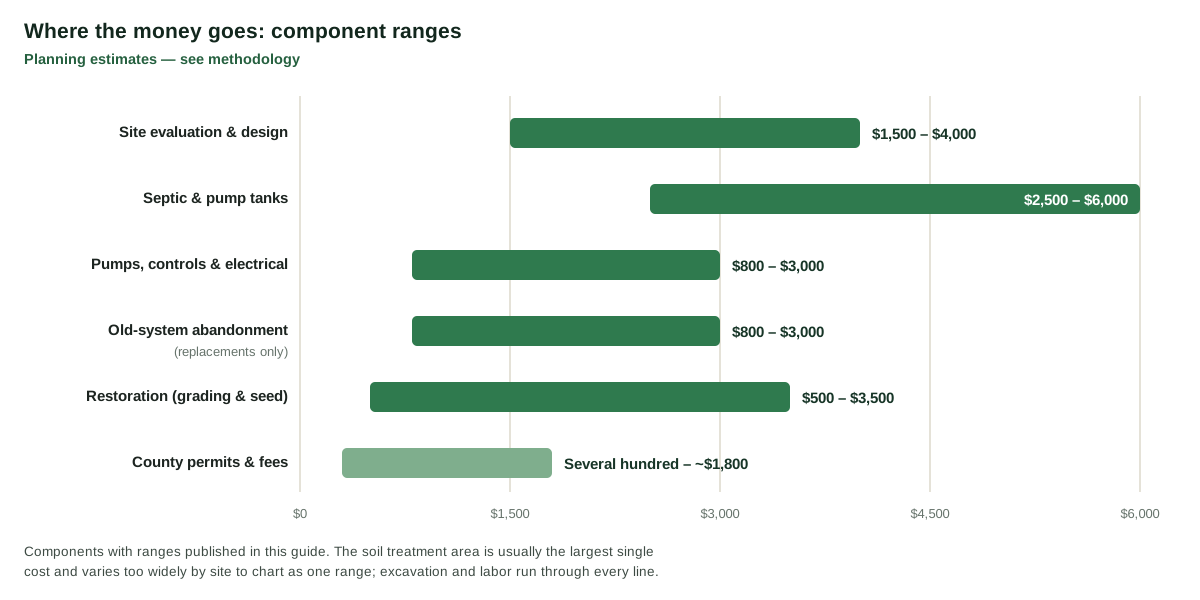
Where the money goes: component breakdown
| Component | Typical share / cost | Notes |
|---|---|---|
| Site evaluation & design | $1,500 – $4,000 | Soil borings, evaluation, drawings, permit package |
| County permit & fees | Several hundred to ~$1,800 | Scott County's published fee schedule lists $890 for a residential Type I–III system installed by a licensed installer; advanced systems and Dakota County fees differ |
| Septic & pump tanks | $2,500 – $6,000 | Sized to bedrooms; pump tank and pump where the field is uphill |
| Soil treatment area | The largest single cost | Trenches/beds in native soil at the low end; imported mound sand and construction at the high end |
| Excavation & labor | 30–45% of construction | Crew, machines, trucking; access difficulty shows up here |
| Pumps, controls & electrical | $800 – $3,000 | Effluent pump, floats or panel, alarm, trenching for power |
| Old system abandonment | $800 – $3,000 | Pumping, crushing or removing the old tank, fill and grading (replacements) |
| Restoration | $500 – $3,500 | Final grading, topsoil, seed; full landscaping is extra and often excluded |
An itemized quote should map roughly onto these lines. A single lump-sum number with no breakdown is not automatically dishonest, but it leaves you no way to compare bids or to see what a change would cost.
Estimate your project
Pick the system type your site is likely to need, your bedroom count, and whether this is a new install or a full replacement. The estimator uses only the ranges published in this guide's own tables — nothing else is priced in.
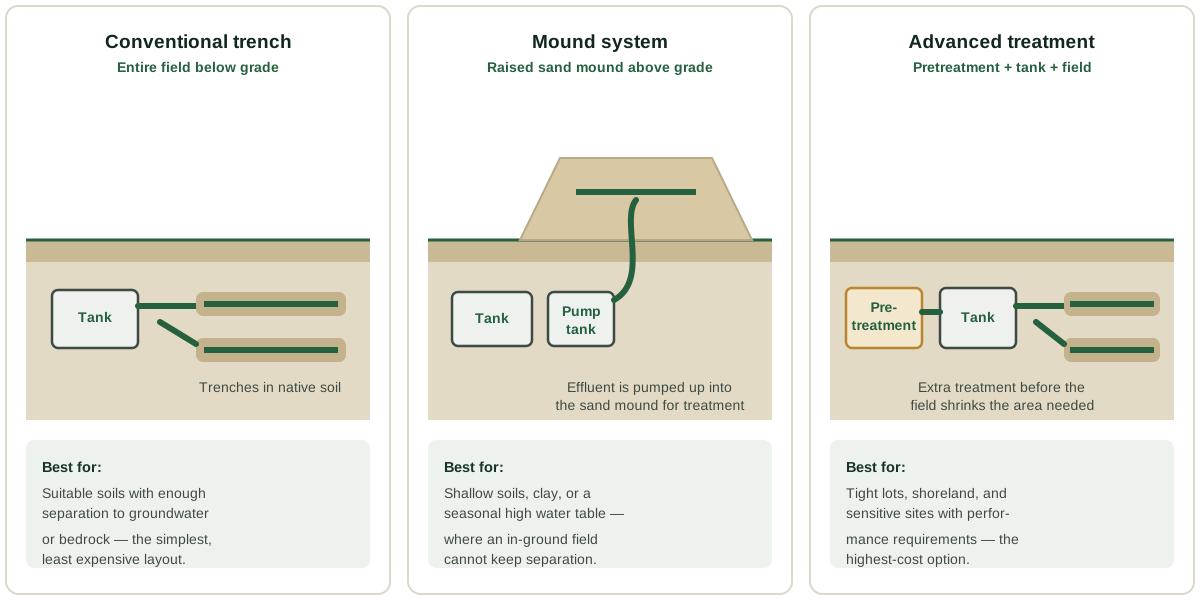
The three system types, side by side
System type is factor number two on the list below, but it deserves a picture of its own: most of the spread between a $15,000 project and a $45,000 one is the jump between these panels.
The six factors that move your price
1. Soil and water table
The master variable. Suitable soil with three feet of separation builds the cheapest system in the catalog. Clay, shallow bedrock, or a seasonal high water table force mounds or advanced treatment and can double the price. This factor is discovered, not negotiated, which is why a quote written before a site evaluation is fiction.
2. System type the site requires
Conventional, mound, and advanced treatment are not trim levels; they are engineering answers to site conditions. Shoreland lots near Cedar Lake, tight lots, and poor soils pull projects up the ladder. A designer's job is to specify the least expensive type that legally fits your ground, and a good one will show you why.
3. Home size and design flow
Bedrooms set the design flow, and flow sets tank size and field size. Garbage disposals, jetted tubs, and home businesses add load that honest design must count. Understating flow to shrink a quote produces a system the county will not permit and a field that dies young.
4. Pumping and elevation
If the treatment area sits uphill from the house — common on the sloped lots around Credit River — the system needs a pump tank, pump, controls, and power. That package adds equipment cost and a maintenance item for the life of the system. Gravity is cheaper wherever the land allows it.
5. Access and site conditions
Excavators, sand trucks, and tank setters need to reach the work area. Tight side yards, fences, mature trees you want kept, long carries from the road, and wet ground all add time or require smaller equipment and more trips. Installers price what they see on the site visit; hiding an access problem does not make it cheaper, just later.
6. County, permits, and timing
Permit and inspection fees differ between Scott and Dakota Counties and by system type, and rush timing costs money when crews are booked. A compliance deadline or a closing date can compress the schedule into premium territory. Starting in the off-season or ahead of a listing is the simplest discount available in this industry.
Two worked examples
A conventional replacement in Credit River
A 3-bedroom home on a large, flat lot with suitable soils loses its 1980s system to a failed field. The project: site evaluation and design ($2,400), permit (about $900), new tanks and conventional trench field ($13,500), old tank pumping and abandonment ($1,600), grading and seeding ($1,100). Total: about $19,500, inside the conventional band, with the large lot and easy access keeping excavation efficient.
A mound replacement near Elko New Market
A 4-bedroom home on clay soil with a high seasonal water table fails its inspection. The project: evaluation and mound design ($3,400), permit (about $900), mound construction with imported sand, pump tank and controls ($33,000), abandonment of the old system ($2,200), restoration ($2,000). Total: about $41,500. Nothing about the house changed; the ground set the price.
Repair vs. replacement: the honest comparison
| Repair | Replacement | |
|---|---|---|
| Typical cost | $300 – $7,500 depending on scope | $12,000 – $50,000+ |
| Right when | Failure is a component: pump, line, baffle, or a localized field section; tank and soils still sound | Soil treatment area is exhausted, tank is not watertight, separation is insufficient, or the system type is no longer legal |
| Documentation | May still require permits and, where triggered, a compliance inspection | New permit, design, county inspection, and a fresh certificate of compliance |
| Risk | Treating a symptom while the field continues to fail | Cost and yard disruption now, in exchange for a 20+ year reset |
The decision rule local installers actually use: repair what is broken if what remains is compliant and has life in it; replace when the failure lives in the soil or the system's legal status. Any quote that skips the diagnostic step and jumps to either answer should be questioned.
Methodology: where these numbers come from
These ranges are planning estimates assembled for this guide from three inputs: published county fee schedules, which fix the permit portion (Scott County's 2026 fee schedule lists residential SSTS permit fees, including $890 for a standard residential system installed by an MPCA-licensed installer, with higher fees for advanced Type IV/V systems); documented local project reporting, such as the City of Elko New Market's engineering analysis that placed mound replacements in the $15,000–$20,000 range in 2016 dollars, adjusted upward for a decade of construction inflation; and current regional installer pricing patterns for the south metro. They are not quotes, and they will not match any individual property exactly. When a range here and a written site-specific quote disagree, believe the quote — after you have verified it is itemized and the installer is licensed.
Last updated: October 2026
Questions to ask any installer before you sign
- What is your MPCA license number, and may I verify it?
- Is this quote based on a site evaluation of my property, and what system type does it assume?
- What is included: design, permits, old-tank abandonment, electrical, restoration? What is excluded?
- Who files the permit and schedules county inspections?
- What could change the price once digging starts, and how are changes approved?
- What documentation do I receive at the end — permit, as-built, certificate?
- How long is the workmanship warranty, and what maintenance does the system need?
New construction vs. replacement: why the same system prices differently
A system for a new home and the identical system replacing a failed one rarely cost the same. New construction starts with a clean site: the designer picks the best soil on the lot, excavation runs before landscaping exists, and there is no old system to deal with. Replacement inherits constraints. The old tank must be pumped, crushed or removed, and its site restored; the new field often has to thread between the house, the well, the driveway, and the reserved alternate site; and crews work around a family that still needs running water at night.
Replacement also carries deadline pressure that new construction usually does not. A failed system under a county correction order or a closing date removes the option of waiting for a quieter season, and installers price urgency honestly. Budget an extra $1,000 to $4,000 over the equivalent new-build figure for abandonment and restoration, and treat any replacement quote that ignores the old system entirely as incomplete.
One offsetting advantage: replacement projects sometimes reuse sound components. A watertight tank in the right location, verified by the designer, can stay in service and save real money. Ask whether reuse is possible on your site; the answer requires inspection, not optimism.
What a system costs to own after installation
The purchase price is the large number, but ownership has a rhythm of smaller ones. Budgeting for them is what separates a 25-year system from a 15-year one, because nearly every premature failure traces back to skipped maintenance rather than bad luck.
| Ownership cost | Typical cost | Frequency |
|---|---|---|
| Tank pumping | $300 – $550 | Every 2–3 years (Scott County expects inspection of tanks at least every 3 years) |
| Effluent filter cleaning | Often included with pumping | With each pumping visit |
| Pump replacement | $600 – $1,500 installed | Every 7–15 years on pumped systems |
| Advanced system service contract | $250 – $600 / year | Annual, where an operating permit requires it |
| Electricity (pumps, treatment units) | $5 – $20 / month | Ongoing on pumped or advanced systems |
Against those figures, weigh the cost of neglect: a drainfield replacement triggered by solids carryover can run $8,000 to $20,000 on its own. Pumping is the cheapest insurance in the entire system, and keeping pumping records also pays at resale, where a documented maintenance history supports the compliance file.
How to compare quotes — and spot a bad one
Collect quotes on the same scope or do not compare them at all. Every bid should name the system type and size, state whether design and permit fees are included, list what happens to the old system, and say what restoration is covered. When one bid is far below the others, the gap is almost never generosity; it is a missing line. The most common missing lines are design fees, old-tank abandonment, electrical work for the pump, and final grading with seed.
Three red flags deserve a hard stop. First, a firm construction price offered before any soil evaluation: the bidder is guessing, and the guess will be revised upward once digging starts. Second, reluctance to provide an MPCA license number or to pull the county permit in the open: unpermitted septic work surfaces at resale and can void the compliance file you will someday need. Third, pressure to skip the designer and "just put in what the neighbor has": soils change across a single lot line, and a copied system can fail its first inspection.
A good quote, by contrast, reads like a small contract: itemized lines, stated assumptions about soil, named exclusions, a payment schedule tied to milestones such as permit approval and passed inspection, and the documentation you will receive at the end. Price matters, but in buried infrastructure the paperwork is part of the product.
Legitimate ways to lower the bill
There is no coupon for a septic system, but owners do control several real levers. Timing is the biggest: designers and installers are busiest from April through October, and a project that can be designed in winter and dug early often meets a hungrier schedule. Second, decide the house plan before the design. Every bedroom added after the design is drawn re-opens engineering and permitting; getting the count right once is free accuracy.
Third, keep the site easy to work. Mowing and marking the area, confirming property corners, moving vehicles and stored materials out of the equipment path, and telling the crew about buried utilities, old tanks, and irrigation lines all prevent billed surprises. Fourth, ask about phasing only where it is real: restoration upgrades like full sod instead of seed can wait a season without touching the system itself, while nothing underground should ever be phased.
Finally, check for assistance before assuming none exists. Minnesota counties have at times offered low-interest septic loans funded through state programs, and availability changes; a two-minute call to the county environmental office can be worth thousands. What never lowers the bill: hiring unlicensed labor, skipping the permit, or undersizing the system. Each converts a discount into a future liability with interest.
Cost questions
Why do quotes for the same house vary so much?
Because installers are not always quoting the same job. One bid may include design, permits, old-tank abandonment, electrical for a pump, and lawn restoration while another covers only tanks and field. Soil risk also gets priced differently. Compare itemized written quotes line by line, and ask what each bid assumes about the system type — a conventional quote on a lot that needs a mound is not a bargain, it is a future change order.
Is a mound system worth the extra money?
A mound is not an upgrade you choose for luxury; it is the compliant solution when soils or groundwater rule out an in-ground field. On the right lot it performs as well as or better than a conventional system and can serve for decades with normal pumping. The relevant comparison is not mound versus conventional on the same lot — it is mound versus no legal system at all.
Can I finance a septic replacement?
Many homeowners use home equity products, and some Minnesota counties have offered low-interest septic loan or grant programs funded through state clean-water money, with availability that changes by year and income rules. Ask the county environmental office what is currently open before assuming you must pay cash. Installers may also offer payment terms; compare the total cost of any financing, not just the monthly figure.
Does a new septic system add resale value?
It protects value more than it adds it. In septic country, a documented new system removes the discount buyers and lenders apply to failing or unknown systems, which routinely exceeds the installation cost on contested sales. Keep the permit, as-built, and certificate with your home records so the value is provable at listing time.
What is the cheapest legal way to handle a failed system?
Get the diagnosis first. A genuine repair — a pump, a line, a tank component — can be a tenth of replacement cost when the soil treatment area is still sound. If the field itself has failed or the system is noncompliant by design, money spent patching is usually lost. The cheapest legal path is the one a licensed professional can certify, and it starts with knowing which failure you actually have.
Get the real number for your property
Scott County Septic is a matching service, not a contractor. Your request goes to one independent, MPCA-licensed local installer — never to a call list.
Request received — thank you.
Your matched installer will review your details and contact you about next steps.